Shopify support tickets: the 5 questions that are most of your inbox
Your Shopify support inbox isn't unique. It's five repeat questions in different clothes. Here's how to find your real ticket mix and what AI should answer.
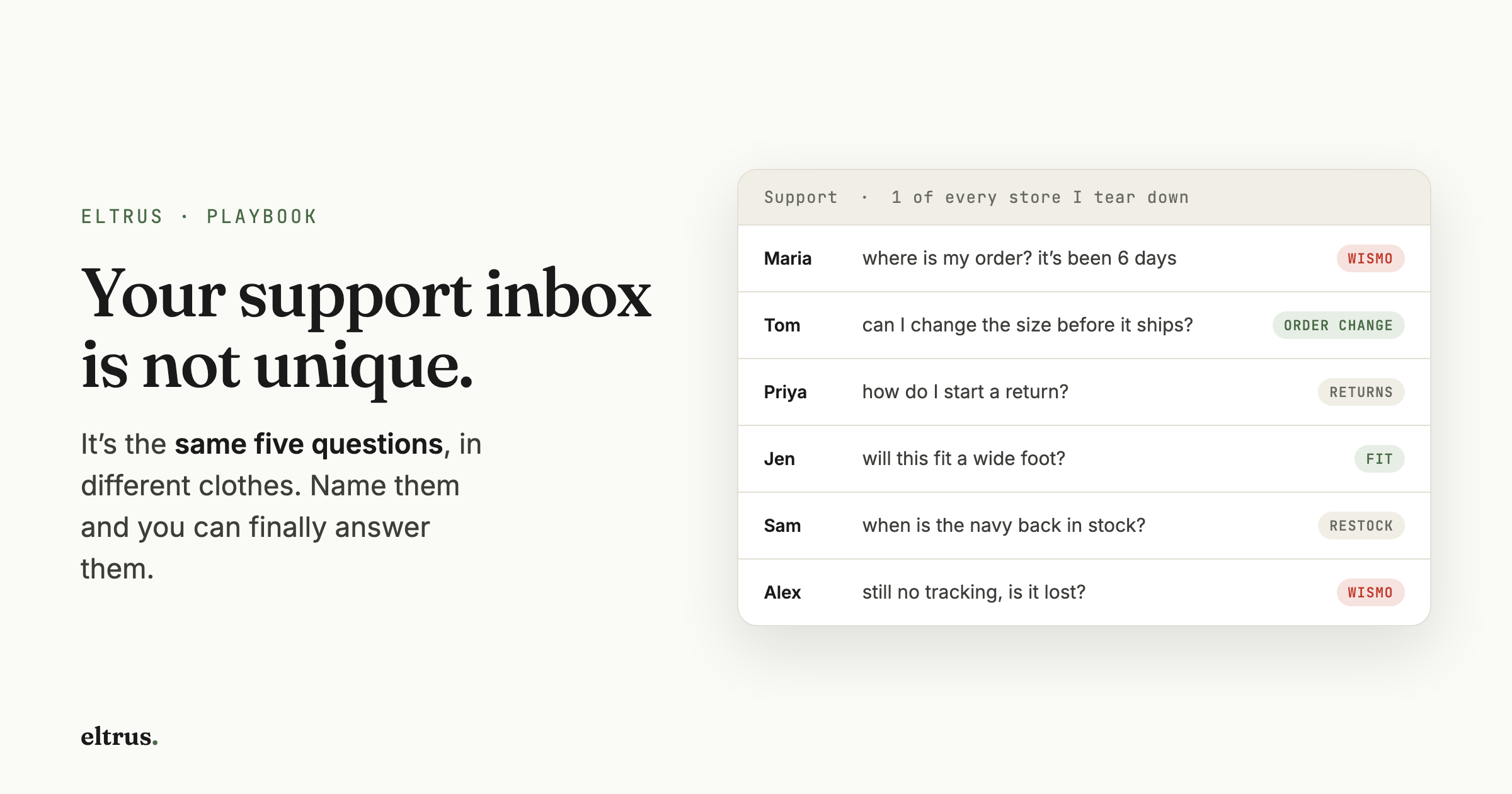
Your support inbox is not unique. You think it is. Every Shopify founder thinks it is. Then you sort a few hundred tickets into buckets and the same short list falls out of nearly every store: where’s my order, can I change it, what’s your returns policy, will this fit, is it back in stock. The wording changes. The questions don’t.
This matters because you can’t deflect what you haven’t named. “We get a lot of tickets” is not a plan. “Forty percent of our tickets are WISMO, and most land in the 48 hours after dispatch” is. So before anyone sells you AI, a chatbot, or a shinier helpdesk, do the boring thing first. Find out what your shoppers actually ask, in what proportion, at what moment.
The five buckets that cover most of it
Read a representative sample of recent tickets, a few hundred is plenty, and most of them land in five buckets:
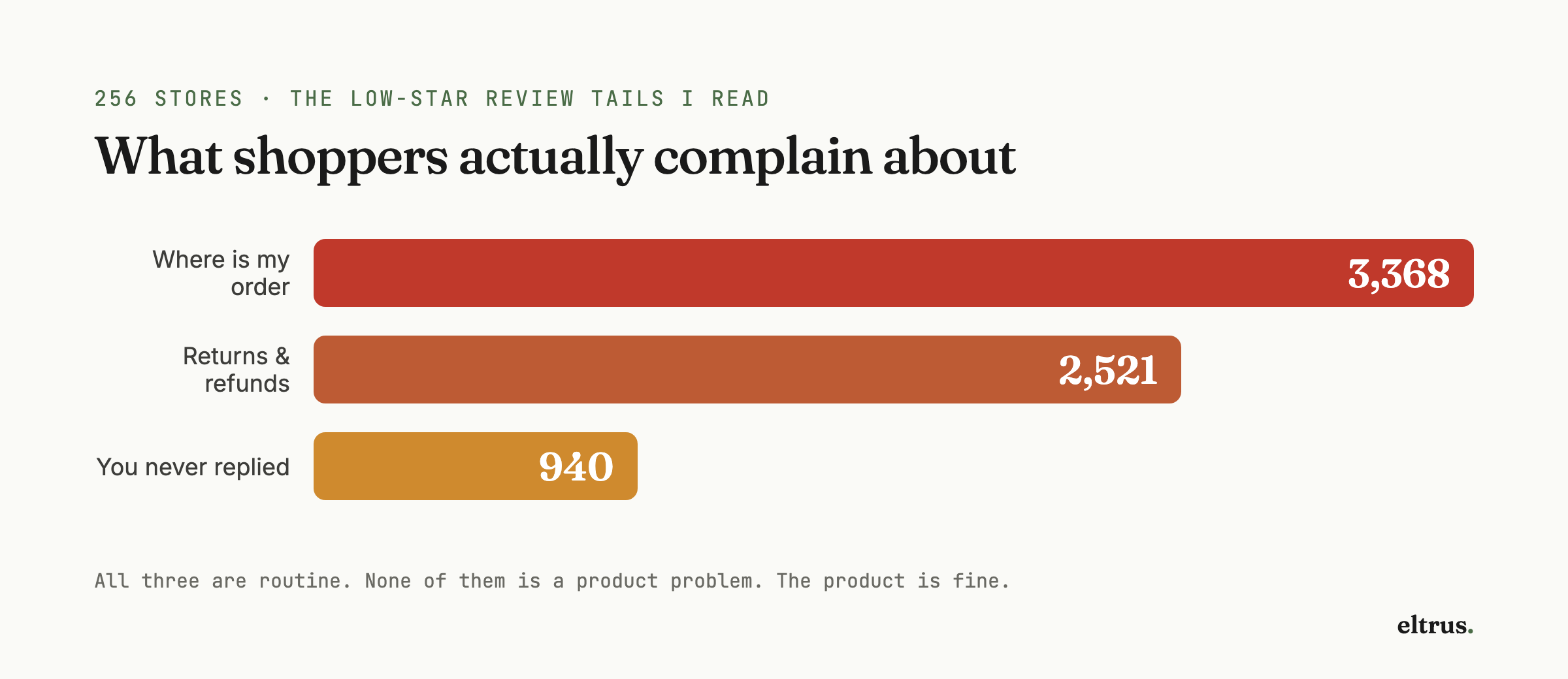
- WISMO, where is my order. Tracking, “has it shipped”, “it says delivered but it isn’t here”. Almost always the single biggest bucket for a physical-product brand. Across the 1-star tails of the 256 stores I’ve torn down, “where is my order” is the largest real complaint category by a distance.
- Order changes. Wrong size, wrong address, “can I add an item”, “cancel before it ships”. Time-sensitive and emotional, because the window is closing while they wait for you.
- Returns and exchanges. How do I start one, where’s my refund, can I swap instead. The second-biggest real category in those same tails, behind only WISMO.
- Pre-purchase fit and product questions. Sizing, ingredients, compatibility, “will this react with my skin”. These are not a cost. Answered fast, they’re a sale in progress.
- Stock and restock. “When is this back”, “notify me”, “do you have it in another colour”.
The proportions move with the category. A supplement brand skews to “which product is right for me”. An apparel brand drowns in fit and returns. A furniture brand has fewer tickets, each one slow and high-stakes. The shape holds well enough that if your mix looks wildly different, that itself is the finding, and it usually points at one specific thing broken upstream.
Volume is the wrong number. Timing is the right one.
The mistake I see most is treating tickets as a flat pile to shrink. They aren’t flat. They cluster, and the cluster is the signal.
WISMO is the clearest case. The volume isn’t spread across the order lifecycle. It spikes in a narrow window after dispatch, when the shopper has a confirmation email and a tracking number that hasn’t moved yet. That is not a support problem. It is a communication problem wearing a support costume. The fix is a better post-purchase email or a clearer tracking page, not a faster agent. Look at total WISMO volume and you’ll try to answer the tickets quicker. Look at when they arrive and you’ll stop a chunk of them being sent at all.
Order-change tickets have the opposite timing. They’re a race. The shopper wants to change something before it ships, and every hour you take to reply shrinks the chance you can still do anything. A late answer here isn’t a slow answer. It’s a useless one, and it becomes a return or a chargeback. These are the tickets where reply speed changes the outcome, which is exactly why they’re a candidate for automation that can act, not just reply.
Which tickets should AI actually touch
Once you have the mix, the deflection decision gets calm, because the buckets sort themselves into three.
Answer instantly, no human. The policy-shaped questions where the answer is the same every time and already lives on a page: returns policy, shipping timelines, “how do I start a return”, restock alerts. If the answer is written on your site, a shopper shouldn’t open a ticket and wait a day to have it read back to them. This is the cleanest, safest deflection there is, and usually the largest single win.
Resolve with a lookup. WISMO and order status are repetitive and personal. They need the shopper’s actual order, not a policy. Deflectable, but only if the automation can securely read real order state and tell the truth about it. Done well, this is the highest-leverage bucket, because it’s your biggest volume and genuinely automatable. Done badly, it’s where you lose trust fastest. A confident wrong answer about someone’s missing parcel is worse than no answer.
Keep human, on purpose. Two kinds. The emotional and the commercial. A genuinely upset customer, a damaged delivery, an edge-case complaint, these want a person, and trying to deflect them is how you end up in a 1-star review quoting your own chatbot. And the high-intent pre-sale question, “will this fit me”, “is this safe for my condition”, is not a cost to deflect at all. It’s the sale. The goal there isn’t deflection. It’s a fast, accurate answer, whoever or whatever gives it.
Naming the mix isn’t about automating everything. It’s about being deliberate. Automate the boring repeatable stuff so your humans have time for the tickets where a human actually changes the outcome.
How to find your mix this afternoon
You don’t need a tool to start. Pull your last two or three hundred tickets, read them, tally them into the five buckets plus an “other”. You’ll have an honest picture in an afternoon, and it’ll beat whatever your helpdesk auto-tagged, because auto-tagging is exactly the kind of repetitive judgement that’s wrong in quiet, consistent ways.
If you want the version that also tells you which of your tickets are safely automatable, where your own help content already answers the question versus where it silently doesn’t, that’s most of what I do in a support audit. I take a real store’s public support surface and ticket patterns apart and hand back the mix, the deflection candidates, and the ones to leave well alone. There’s a full sample audit on the site if you want the shape of it first.
Either way, start with the mix. What to automate, what to keep human, whether you even need new tooling, all of it gets easier the moment you know what your shoppers are really asking.